

Most design teams will tell you they’re doing AI-native design. What they usually mean is that their designers have some sort of AI copilot license and someone on the team figured out how to generate wireframes with a prompt.
That’s not AI-native. That’s AI-aware. And the distance between those two things is roughly the distance between buying a camera and knowing how to see.
I started seeing these patterns firsthand. Now I’m mapping the framework so other organizations can see them too. This article captures the first set of findings from that ongoing work.
The focus is not on tools, but on the practice itself. How work gets structured. How decisions get made. How teams organize around a fundamentally different way of building. What’s becoming clear is that most organizations are solving for the wrong problem. The ones that identify the right problem first will gain a significant competitive advantage.
Here’s the distinction that clarified everything for me.
Three Stages, One Question
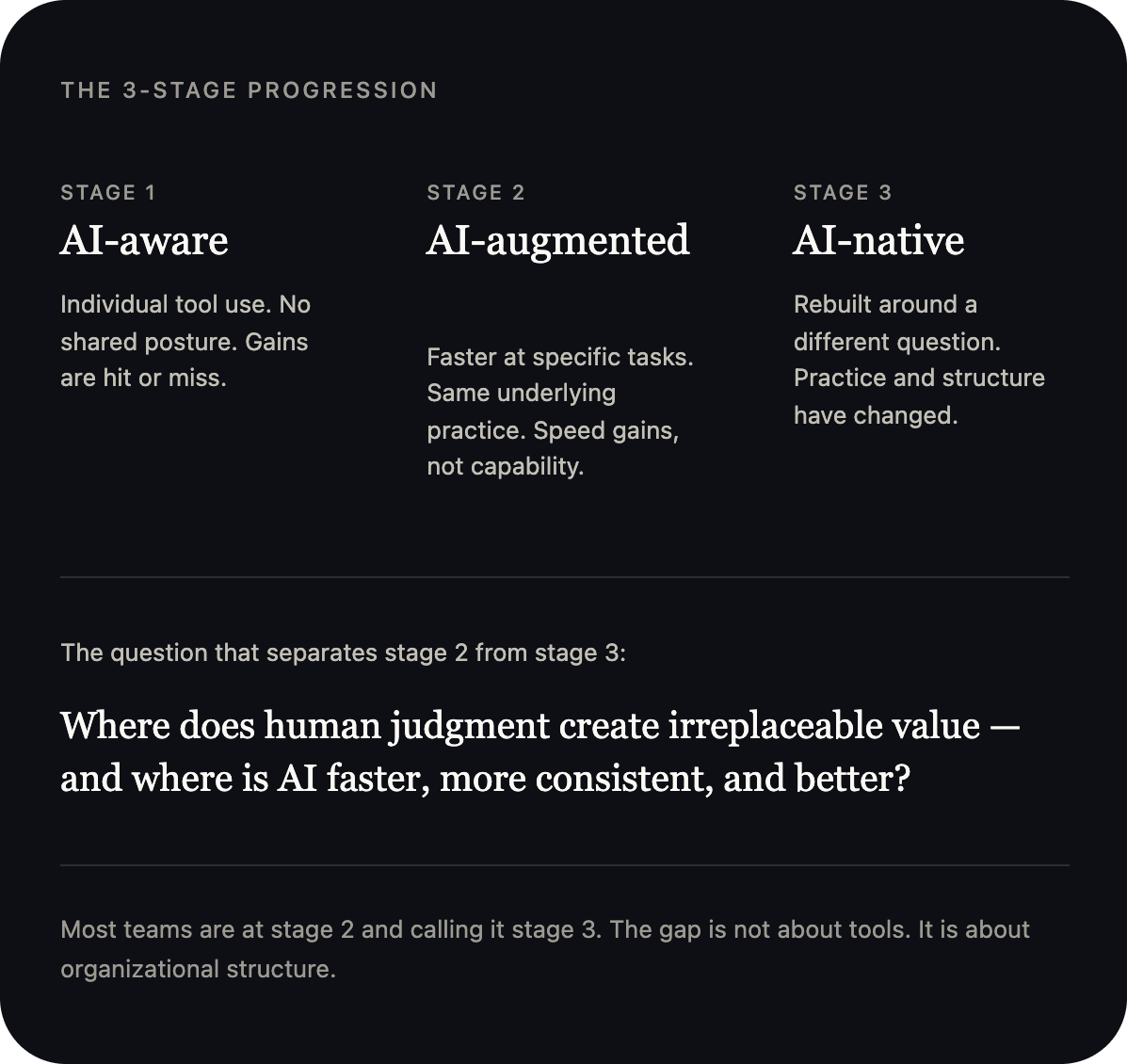
Design organizations are currently at one of three stages in their relationship with AI.
In the first stage is AI-aware, this is when the team knows the tools exist and some individuals use them on their own. There’s no shared organizational posture. The gains are individual and a hit or miss.
Then there is AI-augmented, this means the team has identified specific phases of work where AI can accelerate output, things like research synthesis, visual exploration, and first draft copy. The gains are more consistent, but they are gains in speed, not capability. The underlying practice has not changed; the organization is simply running the same race faster. This is exactly where I found myself, and it became the catalyst for my research into what lies beyond just ‘faster’.
Lastly, there is the AI-native stage. This is something different. It means the organization has rebuilt around a different question entirely: where does human judgment create irreplaceable value (human-led value), and where is AI faster, more consistent, and better (AI-led execution)?
This isn’t a question about tools. It’s a structural question about the organization. And answering it honestly takes more courage than most teams are prepared for, because the honest answer often reveals that a significant portion of what designers spend their time on falls into the second category of AI-led execution.
What Actually Changes
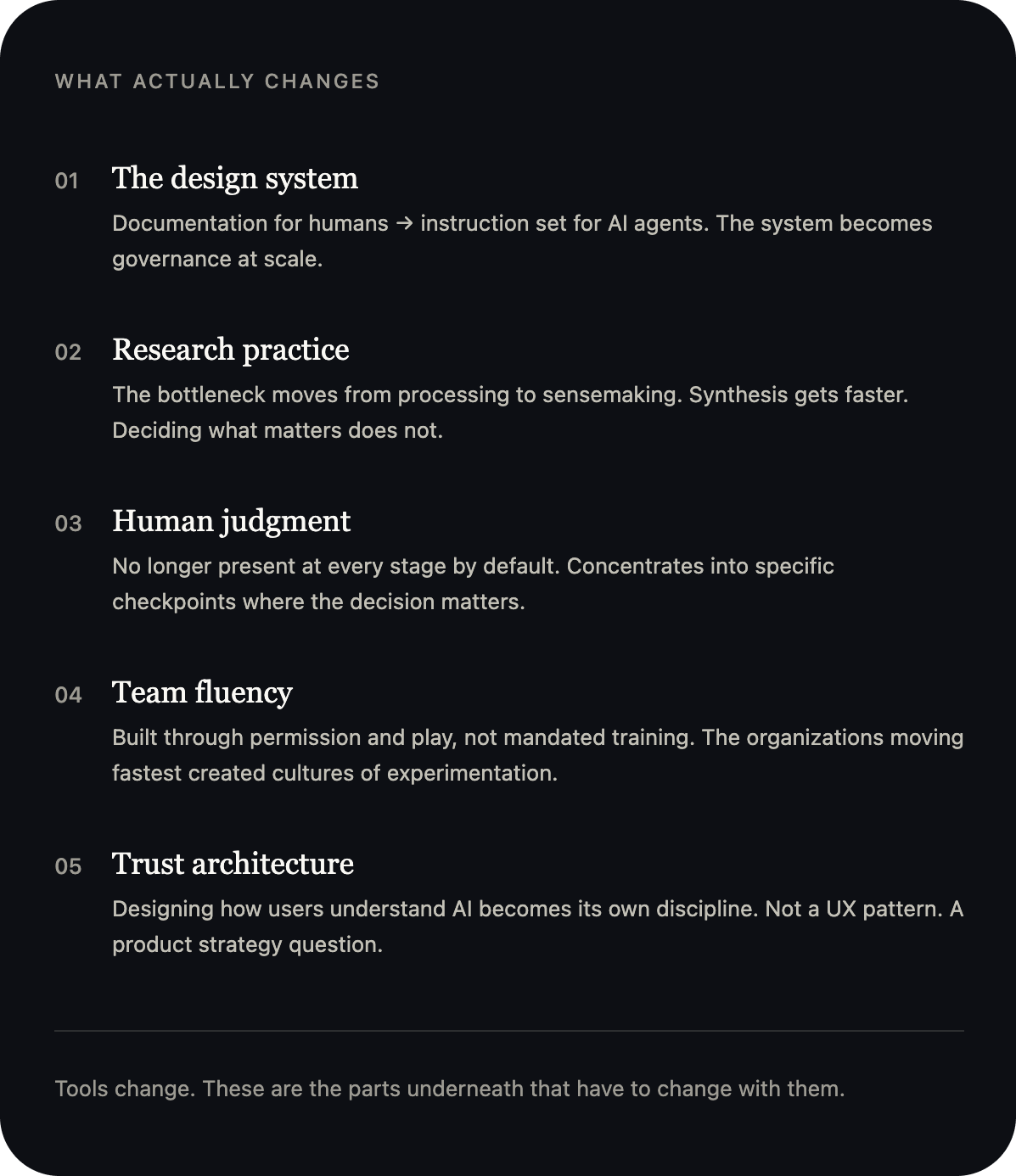
When you take this question seriously, five things shift.
The Design System
In most organizations, the design system is documentation. A Figma file and a Storybook that engineers sometimes look at. In an AI native organization, the design system becomes the instruction set that governs everything AI produces. It does not just tell human designers what to do. It tells AI coding agents which components to use, what the tokens mean, which patterns are on brand, and which are hallucinated approximations.
Teams at Atlassian and Figma have already started building this layer. The MCP server that Figma announced at Schema 2025 brings design system context directly into developer workflows so AI agents can generate code that actually reflects the design system, including component names, spacing, and accessibility properties, without manual reinterpretation at every handoff.
If you build this infrastructure now, you have quality governance at scale. If you do not, AI output slowly erodes product consistency from the inside creating both technical and design debt.
Research Practice
Research practice is shifting too. AI does not replace user research, but it does change how the work happens. Synthesis that once took a week can now take hours. The bottleneck moves from processing the research to making sense of it. The real work becomes deciding which patterns actually matter and what they mean for the product. That kind of decision still requires context, empathy, and a deep understanding of the problem space. An AI native research practice is not just about moving faster. It is about using that time to focus on the moments where human judgment matters most.
Human Judgment
Another shift is how human judgment is now applied. In a traditional design process, human judgment is present at every stage simply because humans are the ones doing the work at every stage. In an AI native process, AI is doing significant portions of the work. Human judgment does not disappear. It concentrates into specific checkpoints. The design leader’s job becomes identifying exactly where those moments exist in the workflow and making sure the right people are present for them. In these moments, the goal isn’t to review AI output passively. The goal is to make real decisions.
Team Fluency
Equally important is team fluency. The organizations moving fastest are not the ones that mandated AI training. They are the ones that built cultures of hands-on experimentation, created safe spaces to try and fail, and established internal champions who help others find their first real “aha” moment with the tools. Figma ran something called the Great Figma Bake Off, a company-wide competition to build projects with live jam sessions in every time zone. Atlassian trained more than a thousand designers through their AI Product Builders Week. In both cases, the tool was never the point; it was giving people the permission to “play”.
Trust
And finally there is trust. As AI becomes more embedded in product experiences, designing how users understand what AI is doing, when to trust it, how to correct it, and what it can and cannot do becomes its own discipline. Trust architecture. This is not a feature or a UX pattern. It is a fundamental product strategy question that touches retention, conversion, legal exposure, and brand. Design leaders who understand this can speak credibly to a C suite about AI risk in terms the C suite actually cares about. Right now, most leaders are still struggling to bridge that gap.
Why Most Teams Are Getting This Wrong
The mistake most organizations make is treating AI-native as an upgrade to the tools layer: Buy the right licenses, train the team on prompting, integrate AI into a few workflows, and declare victory.
What this misses is that the practices and structures underneath the tools haven’t changed. The handoff process still produces the same bottlenecks. The design system is still documentation that humans wrote for other humans. Yes, the tools are faster, but the organization is still running on a pre-AI operating system.
This is why the companies seeing the strongest results are not necessarily the ones with the most sophisticated AI tools. They are the ones who got the organizational model right first. Then they let the tools serve that model.
The Opportunity This Creates
If you are a design leader who understands this, you have an advantage most don’t yet have. Not because you know more about AI than anyone else. Because you understand that this is fundamentally an organizational design problem. And organizational design is a design problem.
The same instincts that make a great designer are the ones required to build a practice that can use AI well: systems thinking, empathy for the people in the system, and the ability to see what is actually happening instead of what the org chart says is happening. The goal is not just speed. It is better decisions, stronger strategy, and work that scales over time.
The organizations that treat AI native design as a practice rather than just another purchase are already setting themselves apart. The gap is no longer just about speed. It is about which teams are still buying cameras and which ones have learned how to see.
Leslie Sultani is a design leader writing about AI, design practice, and organizational change.
Further Reading
State of AI in Design 2025 — Foundation Capital & Designer Fund. Primary research on where design teams are in their AI adoption and where the practice gaps are.
AI Product Builders Week: How Hands-On Experimentation Is Shaping Atlassian’s Future — Atlassian’s account of their week-long internal program where over a thousand employees built with AI tools together.
Schema 2025: Design Systems for a New Era — Figma’s recap of Schema 2025, including the MCP server announcement and how design systems are being rebuilt for AI-native workflows.